




A Reader’s Plea After a Preventable Tragedy
In a recent reader-submitted OpEd published on NYC Newswire, a Brooklyn resident recounts the first time they were allowed to walk to school alone — a childhood milestone they say 7-year-old Kamari Hughes will never experience.
Kamari was struck and killed by an NYPD tow truck driver on October 26, 2023, while crossing the street on his way to school. The OpEd’s author describes the incident as a “preventable tragedy” and argues that New York City has the tools to stop similar crashes — but has not yet chosen to use them at scale.
The writer joins safe streets advocates in urging City Council Speaker Adrienne Adams to bring a key traffic safety bill, Intro 1138, to a vote before the end of her term and to resist efforts to weaken it.
What Is “Daylighting” — and Why It Matters
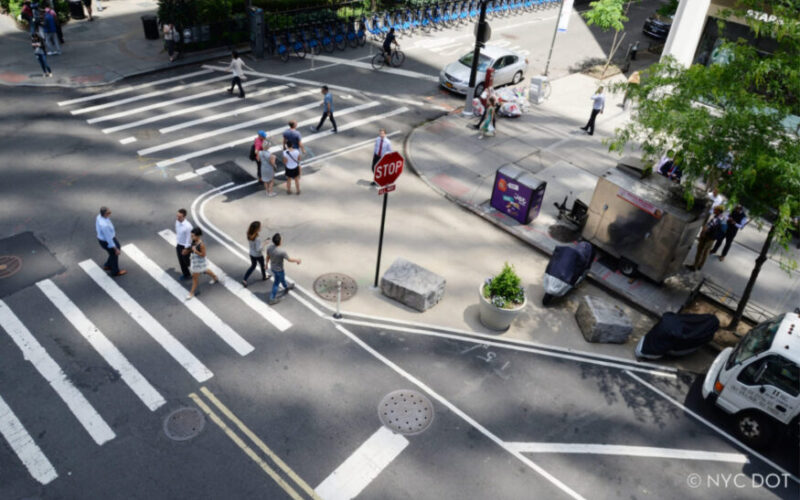
The OpEd centers on “Daylighting”, a street design practice that makes intersections safer by clearing parked cars away from the corners.
In plain terms, daylighting means:
- No cars are allowed to park or stand right up against the crosswalk.
- The space at the corner is kept open or upgraded with safer infrastructure (like planters, bike racks, or barriers).
- This open space makes it easier for drivers to see people in the crosswalk, and for people crossing to make eye contact with drivers.
Advocates say that one lost parking space per corner can dramatically improve visibility and reduce crashes — whether you’re walking your child to school, biking to work, or driving through an intersection.
The OpEd points to other cities:
- In San Francisco, crashes fell after daylighting was implemented at intersections.
- In Hoboken, daylighting helped contribute to a 30% reduction in pedestrian injuries and is credited as a key factor in the city having no traffic deaths for over eight years.
The author argues that New York City should apply the same model citywide — not only on a handful of “model” blocks or after someone has been killed.
What Intro 1138 Would Do, in Plain Language
Intro 1138 is a bill in the New York City Council that would put daylighting into law across the five boroughs.
According to the bill:
- No parking or standing within 20 feet of a crosswalk at an intersection
This means drivers would no longer be allowed to park or stand their vehicles right up against the corner. That 20-foot buffer would be kept clear so everyone can see each other when crossing. - Citywide education and outreach
The City would be required to launch education and outreach efforts so drivers, pedestrians, and businesses understand the new rules and why they matter. - At least 1,000 intersections daylighted per year
The bill would amend the administrative code to require the Department of Transportation to install physical daylighting barriers (such as posts, planters, or other treatments) at a minimum of 1,000 intersections every year.
That turns the idea into a systemic, measurable program, rather than occasional, one-off projects.
If the bill becomes law, most of its provisions would take effect 180 days after it’s signed, with some sections taking effect slightly later and one section taking effect immediately.
Who Is Backing the Bill
Intro 1138, formally titled:
A Local Law to amend the administrative code of the city of New York, in relation to prohibiting standing or parking a vehicle within 20 feet of a crosswalk at an intersection, has a long list of backers at City Hall.
The bill is sponsored by Council Members Julie Won, Erik Bottcher, Tiffany Cabán, Selvena Brooks-Powers, Crystal Hudson, Lincoln Restler, Shekar Krishnan, Christopher Marte, Shahana Hanif, Carmen De La Rosa Abreu, Sandy Nurse, Rita Joseph, Keith Powers, Alexa Avilés, Chi Ossé, Justin Brannan, Carmen De La Rosa, Jennifer Gutiérrez, Pierina Sanchez, Oswald Feliz, Julie Menin, Diana Ayala, Darlene Mealy, Amanda Farías, Gale Brewer, Lynn Schulman, Susan Zhuang Morano, and the Public Advocate Jumaane Williams, in conjunction with the Brooklyn, Manhattan, and Queens Borough Presidents.
Advocates Say NYC Is Behind the Curve
The OpEd notes that Universal Daylighting is already required statewide, but New York City has carved out an exemption for itself. As a result, advocates argue, some neighborhoods enjoy safer street designs, while lower-income communities and communities of color are routinely left behind.
The author criticizes the pattern of installing safety measures only after someone has been killed or seriously injured, and only when local residents have time and capacity to fight for change — often against opposition from a small number of people worried about losing parking.
They say it is unacceptable to tell grieving families that nothing could be done until “after blood was shed,” especially when proven street designs already exist.
A Call to Action for Speaker Adams and the Council
The OpEd’s central demand is clear:
- Bring Intro 1138 to a vote.
- Secure a veto-proof majority.
- Resist efforts to water down the bill to preserve parking at the expense of visibility and safety.
For the author and other safe streets advocates, Universal Daylighting is not just a planning concept; it’s a citywide commitment to prevent future deaths like that of Kamari Hughes. They argue that a simple change — keeping 20 feet at every corner clear and building out daylighting barriers at scale — can help ensure that more children get to experience something as basic as a safe walk to school.
Subscribe to NYCPolitics.com for insights and updates on New York City Politics






Leave a Reply